Garmin, Oura, Apple Health: Three Numbers for the Same Night
Your watch, your ring and Apple Health give you three different HRV values for the same night. Here is why, and how to get a number you can actually use.

You wake up, reach for your phone and open three apps. Garmin shows an HRV that says take it easy. Oura shows one that says go hard. Apple Health has a third number that looks unrelated to either.
Same night. Same body.
So which one is right?
Forums usually answer that with a shopping recommendation. I think the question itself is off. The three devices aren’t measuring the same thing. They differ in four ways: the sensor, the time window, the formula, and whether they look at the whole night or just a moment of it.
Finger, Wrist, Chest
Watches and rings measure optically. Green light shines into your skin and a sensor tracks how much comes back. Each heartbeat pushes a little more blood through the vessels, so the signal rises and falls with your pulse. A chest strap reads the heart’s electrical signal directly.
For heart rate, that barely matters. For HRV, it does. HRV describes how much the gaps between individual beats vary, and those differences are measured in milliseconds. The electrical signal has a sharp spike. The pulse wave at your wrist is a soft hill, and the algorithm has to guess where exactly its peak sits.
Dial and colleagues put numbers on this in 2025. Thirteen adults wore a Polar H10 chest strap as the reference, plus several wearables at once, for a total of 536 nights. Mean absolute percentage error for overnight HRV:
- Oura Gen 4: 5.96%
- Oura Gen 3: 7.15%
- WHOOP 4.0: 8.17%
- Garmin Fenix 6: 10.52%
- Polar Grit X Pro: 16.32%
What surprised me: the ring on the finger came closer to the chest strap than anything worn on the wrist. Thirteen people is a small sample, and the authors point out that manufacturers keep changing their algorithms, so these comparisons need repeating. The ranking is a snapshot. The fact that devices disagree systematically is not.
Which Minutes Count
Even with a perfect sensor, you would not get matching numbers, because each device averages over a different slice of the night. According to the same study:
- Oura measures in 5-minute samples and averages across the whole night.
- Garmin also uses 5-minute windows, but averages over the sleep the watch itself detects.
- Polar only uses the first four hours after you fall asleep.
- WHOOP describes its value as a dynamic average weighted towards your last slow-wave sleep stage. The exact method isn’t public.
HRV does not stay flat through the night. Average the first four hours and you get one number; average until the alarm and you get another. Both are correct.
Resting heart rate gets even stranger. Garmin defines it as the lowest 30-minute average within 24 hours, but doesn’t tell you when that window was. The researchers couldn’t line the Garmin value up with the reference at all, so they left it out of the analysis. A number without a timestamp is a number nobody can check.
SDNN Is Not RMSSD
This part is technical, and it’s the one that explains the biggest gaps. Garmin, Oura, WHOOP and Polar report HRV as RMSSD. Apple Health stores it as SDNN. Both describe how much the beat-to-beat intervals vary, but they calculate it differently.
Put simply: RMSSD looks at how much each interval differs from the next one. SDNN looks at how widely all intervals scatter around their average. I’ll skip the formulas themselves; the difference in principle is enough here. In their 2017 review, Shaffer and Ginsberg note that RMSSD is more strongly shaped by the parasympathetic “rest” branch of the nervous system, while SDNN carries both branches. They also warn explicitly against swapping 24-hour, 5-minute and ultra-short values for each other, even when the formula is the same.
Put Apple Health’s SDNN next to Oura’s RMSSD and you’re comparing apples to oranges. When those numbers don’t match, that isn’t a measurement error. It’s expected.
…and the Apple Watch Only Catches Moments
The ring and the Garmin watch condense the night into one value. The Apple Watch instead records HRV as short individual readings spread across the day. A reading at 3 a.m. and one right after your morning coffee end up in the same list.
O’Grady and colleagues tested the Apple Watch Series 9 and Ultra 2 in 2024: 39 adults over 14 days, again against a Polar H10 chest strap. For resting heart rate, the watch was off by just 0.08 beats per minute on average. For HRV, it underestimated by 8.31 ms on average, with a mean absolute percentage error of 28.88%.
By now the pattern is familiar. Heart rate is robust. HRV is fragile. You can trust your wrist for resting heart rate. For HRV, you need to look closer.
Sleep follows a similar story. In 2021, Chinoy and colleagues compared seven consumer sleep trackers against a sleep lab recording in 34 adults. Most devices did a decent job of telling sleep from wake, though the two Garmin models did worse there. Sleep stages were inconsistent across devices. So if two devices report different amounts of deep sleep for the same night, that’s exactly what this study would lead you to expect.
What to Do With All This
Buying another device won’t fix it. What fixes it is no longer pitting the numbers against each other.
- One source per metric. Pick a device for each value and stick with it. HRV from whatever you wear every night. Resting heart rate can come from somewhere else.
- Trends, not absolutes. The absolute number depends on the device. Whether your HRV has been below your own average for a week tells you something about you. A single day on its own tells you little.
- Mark device switches. Move from a watch to a ring and your chart will show a step. Your body didn’t take it.
- Keep Apple Health HRV separate. SDNN and RMSSD belong on different charts.
If you’ve read the two scale posts, this will sound familiar. With overnight weight swings and with body fat on two scales, the same rule came out: one device, one routine, the trend over weeks.
Your Devices Disagree. obseed Explains Why.
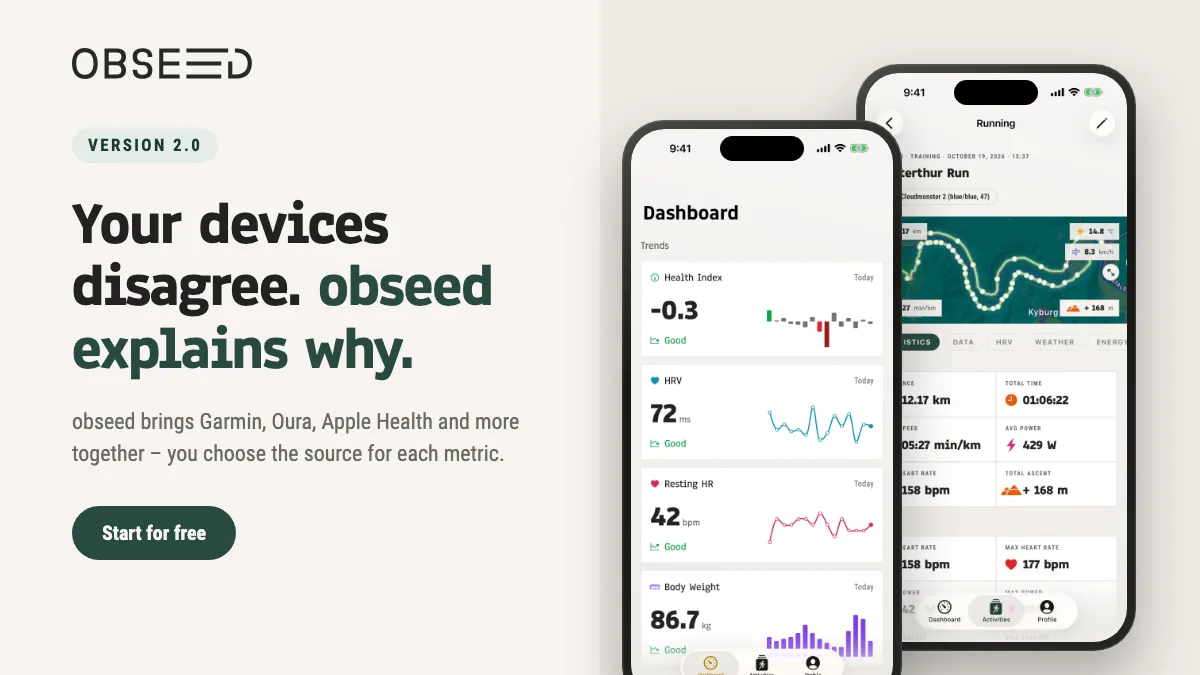
That’s the line we shipped obseed 2.0 for iPhone and iPad with on October 21. The “why” is this post. The app is what lets you act on it.
obseed brings Garmin, Oura, Apple Health and other sources together. In the app you choose, per metric, which source takes priority, and you can see for each provider how recent its latest data is. “One source per metric” stops being a matter of discipline and becomes a setting.
Apple Health sync now runs through a queue that survives interruptions. Your profile shows the sync status and every single sync attempt, and one tap starts a manual sync. When a number is missing, you can tell whether it never arrived or whether the sync is stuck.
For the long view, health reports and weekly summaries live right in the app, and reports can be shared as a PDF. There’s also a guided daily check-in, a weekly review, and the feed with your insights.
obseed won’t turn a wrist sensor into a chest strap. You decide which device delivers your HRV. obseed then sticks to that decision.
One question keeps nagging me: if someone wears two devices on the same night, how far apart are the values, and does that gap stay constant over months? If it does, it’s a kind of personal conversion factor. If it doesn’t, things get really interesting.
Sources
- Validation of nocturnal resting heart rate and heart rate variability in consumer wearables – Physiological Reports, 2025
- An Overview of Heart Rate Variability Metrics and Norms – Frontiers in Public Health, 2017
- The Validity of Apple Watch Series 9 and Ultra 2 for Serial Measurements of Heart Rate Variability and Resting Heart Rate – Sensors, 2024
- Performance of seven consumer sleep-tracking devices compared with polysomnography – Sleep, 2021
Read Next

The Tracker Tango in the Data Jungle: Which Device Should I Believe?
Whoop says rest day, Garmin says threshold training. Why wearables contradict each other, and why your measurement method matters more than who is right.


Garmin vs Oura vs WHOOP: Which Gives You Better Sleep Data?
Sleep tracking accuracy and metrics of Garmin, Oura Ring, and WHOOP compared. Which device gives endurance athletes the most useful sleep insights?

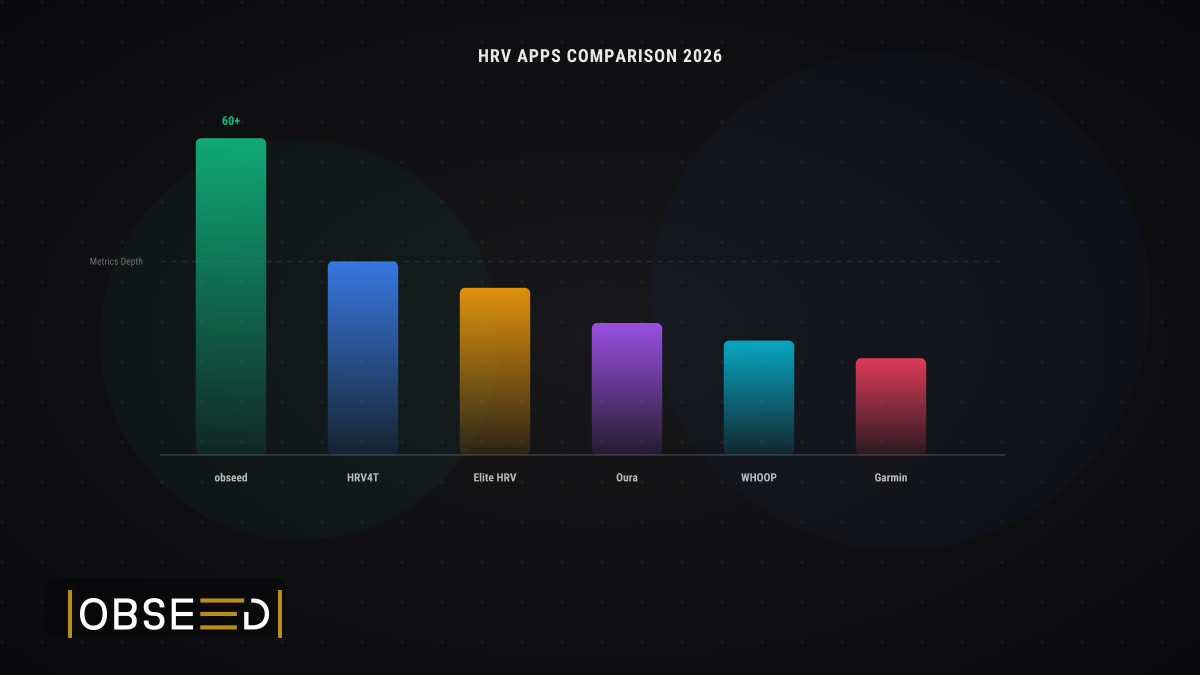
The Best HRV Apps for Endurance Athletes (2026 Comparison)
Comparing HRV apps for runners, cyclists, and triathletes: how obseed, HRV4Training, Elite HRV, WHOOP, and Garmin Connect stack up on metrics and value.