Gained 1.6 kg Overnight? What Your Scale Is Not Telling You
I weigh myself on two scales every morning. After a poker night, both showed +1.6 kg. What in my data is noise, and when you can see the real direction.

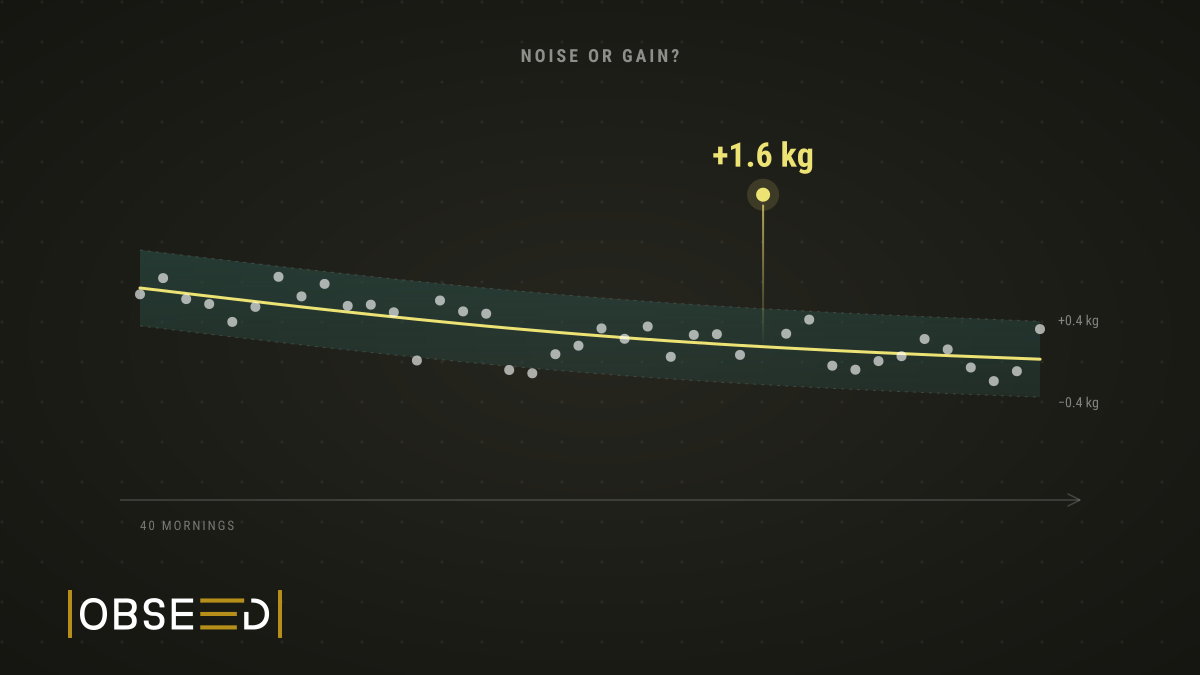
Sunday morning, October 18. I step on the scale: 87.97 kg. On Saturday it was 86.36. The second scale, a different brand, shows +1.62.
Two devices, same result. So it must be true.
Is it? Last night was poker at friends’ place, an hour’s drive there and back, chips, cake, pizza later on. But a kilo of fat is usually put at around 7,700 calories (as in this reel), so 1.6 kg would take a good 12,000. I don’t eat that much even on a bad night.
This is the first of two posts. It answers the question everyone who weighs themselves regularly asks: Is this a real gain, or just noise? Part two takes the body fat reading apart.
The morning protocol
My data come from a fixed routine: get up, bathroom, then the Withings and the Garmin Index right after each other. Around six, almost every day. From the Withings I have 650 mornings since late 2024, from the Garmin more than 2,400 since 2018. All single readings, no averages.
This protocol removes most sources of error (time of day, food, clothes). What’s left is the body itself.
This is one person’s data: a man of around 87 kg who is slowly losing weight. The patterns carry over, the exact numbers don’t. If you fluctuate more, for example because of your cycle, you’ll need more patience than I do, not less.
The scale jumps, the trend stays calm
The scale jumps, the trend stays calm
Morning weight (Withings), Jul 28 to Oct 19, 2026. The band shows the normal range of ±0.4 kg around the 7-day trend. The numbers mark social evenings.
After four out of five evenings, my weight was above the normal range the next morning, after the fifth one a day later. Where the data reach far enough, it was back inside after two to three days. The biggest jump (+1.6 kg) came after the poker night on Oct 17.
The band is narrow: a normal morning sits about 0.4 kg off the trend. The median day-to-day change is 0.39 kg, up or down, and one change in ten is larger than 0.95 kg. The markers are the outliers, and almost all of them have a name.
I tag evenings in obseed when something unusual happened. The label “Social gathering” shows up 14 times in the data. Nine times, my weight the next morning was more than 0.5 kg higher. Across all mornings, that’s true for only 18%.
Two caveats. A missing label means “not logged”, not “didn’t happen”. I don’t tag every evening. Days without a label are therefore not a clean comparison group, and the effect is more of a lower bound. And: the evenings mostly fall between Friday and Sunday. With the weekday factored out, the next morning is still 0.61 kg higher (median).
Sunday weighs more
This isn’t just my problem. A study of 80 adults with more than 4,600 daily readings (Orsama et al., 2014) found that weight rises from Saturday, peaks on Sunday and Monday, and drops from Tuesday on. For me, the Withings shows: Sunday +0.25 kg, Monday +0.11 kg above my 7-day mean, Thursday −0.20 kg. The Garmin, with more than 2,400 mornings since 2018, shows the same pattern, just flatter: Sunday +0.08 kg, Monday +0.07 kg.
And my Sunday evening is often a long dinner, usually without a label. That fits with the Monday after the poker night still being +1.5 kg above Saturday.
When do you see the direction?
Under a TikTok video, someone asks: “How often should we realistically be seeing our weights go up?” (original). The answer from my data is uncomfortable. My trend has been falling for months. Even so, on days with a falling trend, my weight was higher than the day before 47% of the time, and more than 0.5 kg higher on 17% of days. The scale contradicts the trend almost every other morning.
For two single weigh-ins, that means: the gap between them decides whether they show the direction. One week apart, the direction is right for me in 73% of cases, eight weeks apart in 87%.
When do you see the direction?
How often two weigh-ins also point down while the trend is falling, by the gap between them. Blue: measured for me (Withings, Jan 4, 2025 to Oct 19, 2026). Line: model for your rate of loss.
After one week, one comparison in four shows the wrong direction. I lose around 0.08 kg per week. According to the model, two weigh-ins only tell me something reliable after around 12 weeks. If you lose 0.5 kg per week, you see the direction after 2 weeks.
In the curve, you can set your own rate and read off how long you need to wait. The slower you lose, the longer you have to be patient. None of this is the scale’s fault. The signal is simply smaller than the noise. The model uses my noise of around 0.4 kg per morning. If you fluctuate more, you wait longer.
The last twelve weeks show how much the weekday matters. My trend fell by 1.01 kg. Anyone who weighed themselves only on Mondays in that time saw −1.78 kg. Anyone who only stepped on the scale on Sundays saw +0.23 kg, a gain. Same body, same twelve weeks. My data don’t point to a best day: over the whole period, Monday showed the wrong direction most often (in 24% of weeks), Friday least often (14%). If you weigh yourself weekly, always use the same day. If you weigh yourself daily, look at the 7-day average.
Sleep, training, salt
What shifts the next morning? I lined up sleep and endurance training from the day before against morning weight, and both scales tell the same story.
A few tenths, in both directions
Change by the next morning in kg (median, Withings), by sleep and endurance training the day before. The band covers 80% of all mornings.
The shorter the night, the heavier the morning. The longer the endurance session, the lighter. Both stay within the normal back and forth.
Under six hours of sleep (19 nights): +0.34 kg the next morning. Eight hours or more: −0.09 kg. That’s about −0.1 kg per extra hour of sleep. After an endurance day of more than two hours: −0.22 kg. Water, glycogen, digestion, not fat.
Possible confounders: if you sleep short, you often ate late or were out. The night after the poker night wasn’t one of those: 7.3 hours of sleep, Garmin Sleep Score 84. The +1.6 kg fit the evening: lots of food, lots of salt, a full gut. Not the sleep.
What I take from it
I no longer look at the single morning. I look at the 7-day trend and at gaps of several weeks. And when the scale shows +1.6 kg on a Sunday, I tag the evening and wait three days.
On Monday the scale showed 87.82 kg, still 1.46 kg above Saturday. I weighed myself anyway and carried on calmly.
Part two is about the number I trust even less than my weight: body fat. Two scales, 6 to 9 percentage points apart, and one entry in the Garmin app that shifted three points at once.
Sources
- Weight rhythms: weight increases during weekends and decreases during weekdays – Obesity Facts, 2014
Read Next
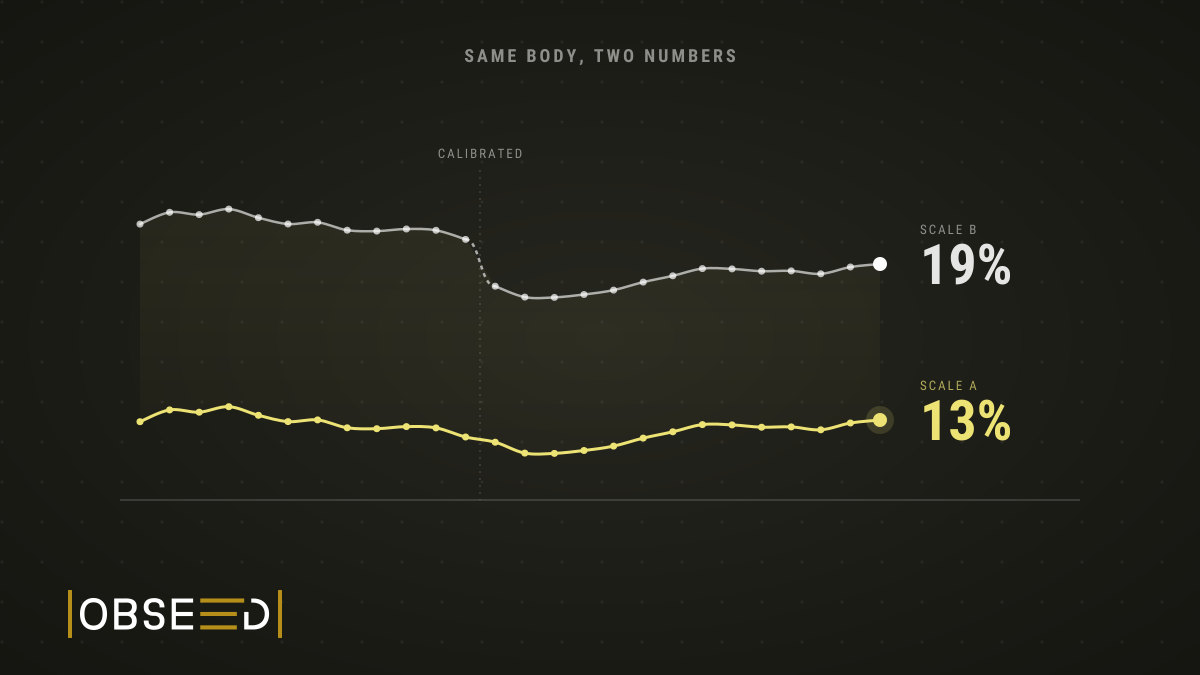
Two Scales, Two Body Fat Readings: Which Do You Trust?
The same 634 mornings, two scales, 6 to 9 points apart on body fat. What the numbers are good for, and which app setting explains almost the whole gap.


Lab or Wearable, That Is the Question: How Do I Know My VO2max Is Right?
A watch does not measure your VO2max, it estimates it. Why that estimate is surprisingly good for recreational athletes and misses for the very best.


The Tracker Tango in the Data Jungle: Which Device Should I Believe?
Whoop says rest day, Garmin says threshold training. Why wearables contradict each other, and why your measurement method matters more than who is right.