The Best HRV Apps for Endurance Athletes (2026 Comparison)
Comparing HRV apps for runners, cyclists, and triathletes: how obseed, HRV4Training, Elite HRV, WHOOP, and Garmin Connect stack up on metrics and value.
A meta-analysis of six randomized controlled trials found that HRV-guided training produced an effect size of 0.40 for VO2max improvements, compared to 0.22 for rigid periodization (Pereira et al., IJERPH, 2020). Heart rate variability has moved from sports-science labs into everyday training. But with over 200 HRV apps currently available on app stores (MDPI Sensors, 2025), choosing the right one isn’t straightforward.
Some apps give you a single readiness score. Others expose time-domain, frequency-domain, and nonlinear metrics that let you fine-tune recovery decisions week by week. Which do you actually need?
This guide compares six popular HRV apps through the lens of what endurance athletes actually need: metrics depth, multi-device support, raw data access, and long-term trend analysis. We’ve used each platform extensively and focused on what matters for runners, cyclists, and triathletes making daily training decisions.
What Matters in an HRV App
Over 200 mobile apps for HRV measurement and feedback are currently available on Apple and Google app stores (MDPI Sensors, 2025). Not every one serves endurance athletes well. The features that matter most go beyond a morning readiness number, especially if you’re periodizing training or tracking adaptation across seasons.
Here’s what separates a useful HRV tool from a novelty:
Metrics depth beyond RMSSD
Most consumer apps report RMSSD (root mean square of successive differences) and stop there. That’s a solid starting point: RMSSD captures parasympathetic activity effectively. But endurance athletes benefit from seeing additional dimensions: frequency-domain metrics like HF power and LF/HF ratio, nonlinear measures like Poincaré SD1/SD2, and fractal indicators like DFA alpha-1.
Why does this matter? Because RMSSD alone can’t tell you whether your nervous system is truly recovering or just showing a superficial bounce-back. DFA alpha-1 shows excellent test-retest reliability for identifying anaerobic thresholds (ICC = 0.97 for power output), and correlates strongly with lactate and ventilatory thresholds (r = 0.88–0.93) (Frontiers in Physiology, 2024). Multiple metrics viewed together give you a more complete autonomic picture.
Device flexibility
88.5% of coaches surveyed use heart rate-related wearable data to individualize training (Springer / Sports Medicine – Open, 2025). Serious endurance athletes rarely stick to one device. You might wear a Garmin watch during training, an Oura ring at night, and a chest strap for threshold tests.
An HRV app that locks you into a single ecosystem limits the data you can collect, and the conclusions you can draw. Wearing two devices? You need a platform that brings both streams together.
Trend analysis and baselines
A single HRV reading means almost nothing. What matters is how today’s number compares to your rolling baseline, and how that baseline shifts across training blocks. Research protocols use 14-day to 4-week baseline establishment periods before HRV values become actionable (Nature Scientific Reports, 2025).
Look for apps that calculate personalized baselines, show coefficient of variation, and let you overlay HRV trends with training load.
Raw data access
Can you export your RR intervals? Can you see the actual beat-to-beat data behind the score? For athletes working with coaches or sports scientists, raw data access isn’t optional. It’s how you validate what the app is telling you.
obseed: Multi-Device Fusion
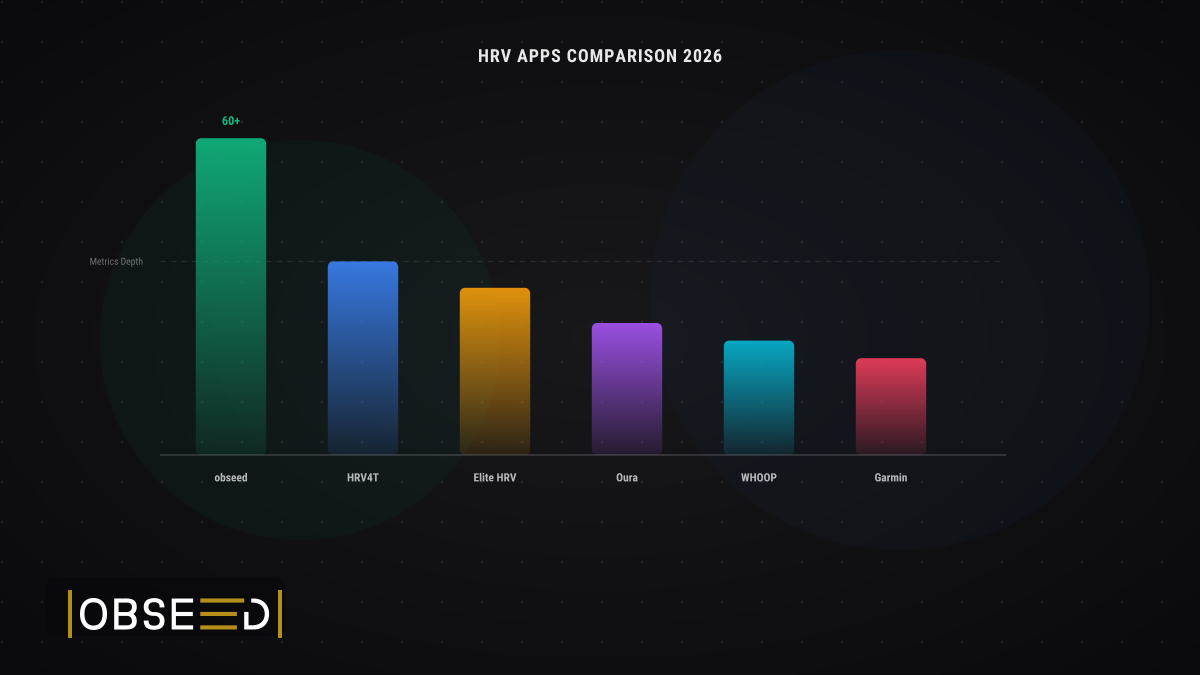
In a 536-night validation study, HRV measurement accuracy across wearable devices varied considerably, from 5.96% MAPE (Oura Gen 4) to 16.32% (Polar Grit X Pro) (Dial et al., Physiological Reports, 2025). obseed approaches HRV analytics differently from most consumer apps: instead of generating one score from one device, it fuses data from multiple wearables into a unified analysis engine with over 60 metrics across 9 physiological categories.
Multi-device data fusion
Connect your Garmin, Wahoo, Polar, Oura, or WHOOP, and obseed pulls RR-interval data from each source and assigns validity tiers based on sensor type and signal quality. A chest-strap recording gets a higher confidence tier than a wrist-based PPG reading. You don’t have to choose one device. You use whatever fits the moment.
Research-grade metric categories
The platform calculates time-domain metrics (RMSSD, SDNN, pNN50), frequency-domain analysis (LF, HF, VLF, LF/HF ratio), nonlinear metrics (Poincaré SD1, SD2, SD1/SD2 ratio), and complexity measures (DFA alpha-1, sample entropy). Each recording generates a report spanning these categories, not just a single number.
Personal baselines and trend overlays
obseed builds rolling baselines from your historical data and flags deviations. You can overlay HRV trends with training load, sleep quality, and tagged lifestyle factors to see what’s actually driving your recovery patterns.
HRV4Training
HRV4Training uses the smartphone camera for morning readings, no wearable needed. In independent validation testing, the app with a Polar H10 chest strap showed a median measurement error of 3% (marcoaltini.com, 2020). Developed by Marco Altini with a strong research background, it’s been a go-to for athletes who want more than a black-box score.
Strengths
HRV4Training uses photoplethysmography for camera-based readings and integrates with Oura and Garmin for passive collection. The app provides RMSSD-based analysis, training load context from Strava or TrainingPeaks, and clear guidance on whether to train hard, easy, or rest.
Its population-based comparisons let you see how your HRV stacks up against athletes of similar age and fitness. The research lineage is solid: Altini has published peer-reviewed validation work on the camera-based method.
Limitations
Metric depth is narrower than research-grade platforms. You get RMSSD and RMSSD-derived readiness, but not frequency-domain breakdowns, Poincaré geometry, or DFA alpha-1. Device fusion is limited; you pick one source, not a composite view. Who does it still work for? If you’re looking for a scientifically validated, affordable entry point.
Elite HRV
Elite HRV (now part of SweetBeatHRV’s ecosystem) was one of the first free HRV apps and built a large user community. It connects to Bluetooth chest straps and finger sensors for morning readings and calculates both time-domain and frequency-domain metrics, which puts it ahead of many consumer alternatives.
Strengths
Elite HRV includes a “Morning Readiness” score and offers historical trend charts. The free tier is generous, and the community forums provide useful context for beginners. The dual-metric approach (time and frequency domain) is a real advantage over apps that only show RMSSD.
Limitations
Development pace has slowed compared to competitors. Wearable integrations are limited; you typically need a dedicated morning measurement rather than passive overnight collection. The interface feels dated, and advanced features like DFA alpha-1 or multi-device fusion aren’t available. Already wearing a Garmin or Oura 24/7? Adding a separate morning measurement creates friction.
Oura
In a 536-night study, the Oura Gen 3 ring achieved an HRV measurement accuracy of 7.15% MAPE (Mean Absolute Percentage Error) compared to the gold-standard ECG, the best score among the consumer wearables tested (Dial et al., Physiological Reports, 2025). Oura’s overnight HRV tracking runs automatically while you sleep, using infrared PPG sensors to capture heart rate variability throughout the night.
Strengths
Passive collection is Oura’s biggest advantage. You don’t need to remember a morning measurement; the ring handles it. Overnight HRV data tends to be cleaner than daytime readings because you’re at rest. Oura also tracks sleep stages, body temperature trends, and respiratory rate: a multi-signal recovery picture. How accurate are the sleep data in detail?
The app’s interface is polished and approachable. For athletes who want a frictionless daily check-in, Oura removes nearly all barriers.
Limitations
Oura reports HRV as a single nightly average (or lowest-5-minute window). You don’t get frequency-domain analysis, Poincaré plots, or DFA alpha-1. The Readiness Score blends HRV with temperature and sleep metrics, which can obscure what’s actually driving the number. There’s no training-load integration; Oura doesn’t know what you did on the bike yesterday.
And the data stays in Oura’s ecosystem unless you export manually or connect to a platform like obseed that pulls it automatically.
WHOOP
WHOOP 4.0 achieved an HRV accuracy of 8.17% MAPE in the same 536-night study: solid, but behind the Oura Gen 3 ring (Dial et al., Physiological Reports, 2025). WHOOP built its brand around recovery optimization for athletes. The strap collects data continuously and presents a daily Recovery Score derived from HRV, resting heart rate, respiratory rate, and sleep performance.
Strengths
WHOOP’s Strain Coach adjusts your daily training target based on your recovery state. For athletes who want a simple “go/no-go” signal, this closed-loop feedback is genuinely useful. The community and team features make it popular among group training environments. Continuous monitoring means WHOOP captures HRV data around the clock, not just during a morning window.
Limitations
WHOOP is a subscription-only service with no free tier; the hardware comes bundled with the membership. You don’t get access to raw HRV metrics beyond what the Recovery Score shows. There’s no RMSSD trend chart, no frequency-domain data, and no way to export RR intervals for independent analysis. For endurance athletes who already own a Garmin or Polar watch, adding a WHOOP strap means wearing two devices. The overlapping data collection can be useful, but only if you have a platform that can fuse both streams.
Garmin Connect
A comparative study showed that chest straps achieve an HRV measurement MAPE of 2.16%, while smartphone PPG hits 17.49%, roughly an 8-fold higher error (Frontiers in Physiology, 2025). Garmin’s wrist-based optical sensors fall somewhere in between, but the accuracy gap to chest-strap measurement remains relevant.
Garmin Connect has made HRV Status available on most modern Garmin watches. Since many endurance athletes already wear a Garmin, this is often the path of least resistance.
Strengths
No extra hardware needed. If you own a Garmin Forerunner, Fenix, or Enduro, HRV tracking is built in. Garmin shows a 7-day HRV status (balanced, low, or high) based on overnight readings and plots your average against a personal baseline. It integrates directly with Training Status, Training Load, and Body Battery, giving you HRV in the context of your running or cycling data.
Limitations
Garmin’s HRV implementation is simplified. You see an average and a status label, but not the underlying RMSSD values, frequency-domain breakdown, or beat-to-beat data. In the 536-night study, the Garmin Fenix 6 scored 10.52% MAPE, noticeably behind Oura and WHOOP (Dial et al., Physiological Reports, 2025).
The data also lives inside Garmin’s ecosystem. If you wear an Oura ring too, those two HRV datasets don’t talk to each other inside Garmin Connect.
Side-by-Side Comparison
| Feature | obseed | HRV4Training | Elite HRV | Oura | WHOOP | Garmin Connect |
|---|---|---|---|---|---|---|
| HRV metrics | 60+ across 9 categories | RMSSD + readiness | Time + frequency domain | Nightly average | Recovery Score | Average + status |
| DFA alpha-1 | Yes | No | No | No | No | No |
| Poincaré plots | Yes | No | No | No | No | No |
| Multi-device fusion | Yes (Garmin, Oura, WHOOP, Polar, Wahoo) | Limited (single source) | Chest strap only | Oura ring only | WHOOP strap only | Garmin only |
| Passive collection | Yes (via connected devices) | Yes (with Oura/Garmin) | No (manual morning) | Yes (overnight) | Yes (continuous) | Yes (overnight) |
| Training load context | Yes (cross-device) | Yes (Strava/TrainingPeaks) | No | No | Yes (Strain) | Yes (native) |
| Raw data export | Yes | Limited | Yes | Manual CSV | No | Limited (FIT files) |
| Free tier | Yes | Limited free | Yes | No (subscription) | No (subscription) | Yes (with device) |
The Right App for Your Stack
HRV-guided training shows nearly double the effect size in amateurs (ES 0.36) compared to elite athletes (ES 0.17) (Pereira et al., IJERPH, 2020). So the right app depends not just on features but also on where you are in your athletic development.
You want simplicity and a daily score
Go with Oura or WHOOP. Both provide frictionless, passive HRV collection and a clear morning readiness signal. Oura works best if you value sleep analysis alongside HRV. WHOOP fits if you want strain-based training guidance.
You want research-backed guidance on a budget
HRV4Training gives you validated RMSSD analysis with training-load context. The camera-based option means you don’t need extra hardware. It’s affordable and well-supported by published research.
You already own a Garmin
Garmin Connect is the zero-effort starting point. HRV Status is built in, and it connects to your existing training data. Just know that you’re seeing a simplified view; it won’t replace a dedicated HRV platform if you want depth. Before you get any HRV data at all, make sure recording is actually turned on: our Garmin HRV activation guide walks you through it step by step.
You want the full picture across devices
obseed is built for athletes who wear multiple devices and want to see all their HRV data in one place, with research-grade metrics, signal quality assessment, and lifestyle correlation through tagging. It’s the deepest option in this comparison, especially for athletes who don’t want to be locked into one ecosystem.
Not necessarily. In a supine position, PPG sensors achieve an RMSSD reliability of ICC 0.955 compared to ECG; seated, that drops to ICC 0.834 (Sensors, 2025). Overnight wrist readings are more reliable than during exercise. Apps like obseed assign validity tiers so you know how much to trust each reading.
Yes, but you'll end up with fragmented data unless you funnel everything into one platform. Most apps lock you into their own ecosystem. A multi-device platform like obseed lets you collect from Garmin, Oura, WHOOP, and others without losing the connections between datasets.
Research protocols use 14-day to 4-week baseline periods before HRV values become actionable (Nature Scientific Reports, 2025). Platforms like obseed backprocess your existing wearable data, so if you already have weeks of Garmin or Oura data, your baseline is available instantly. After about 60 days, seasonal and training-block trends start to emerge.
No. While higher HRV generally indicates better autonomic flexibility, unusually high readings can signal overreaching or illness. What matters is your personal trend relative to your baseline, not the absolute number. Context (sleep, training load, stress) determines whether a high reading is genuinely positive.
Free tiers from apps like Elite HRV, Garmin Connect, and obseed provide useful daily signals for most athletes. The difference with paid tiers lies in metrics depth, historical analysis, and coaching integrations, not measurement accuracy itself.
Read Next
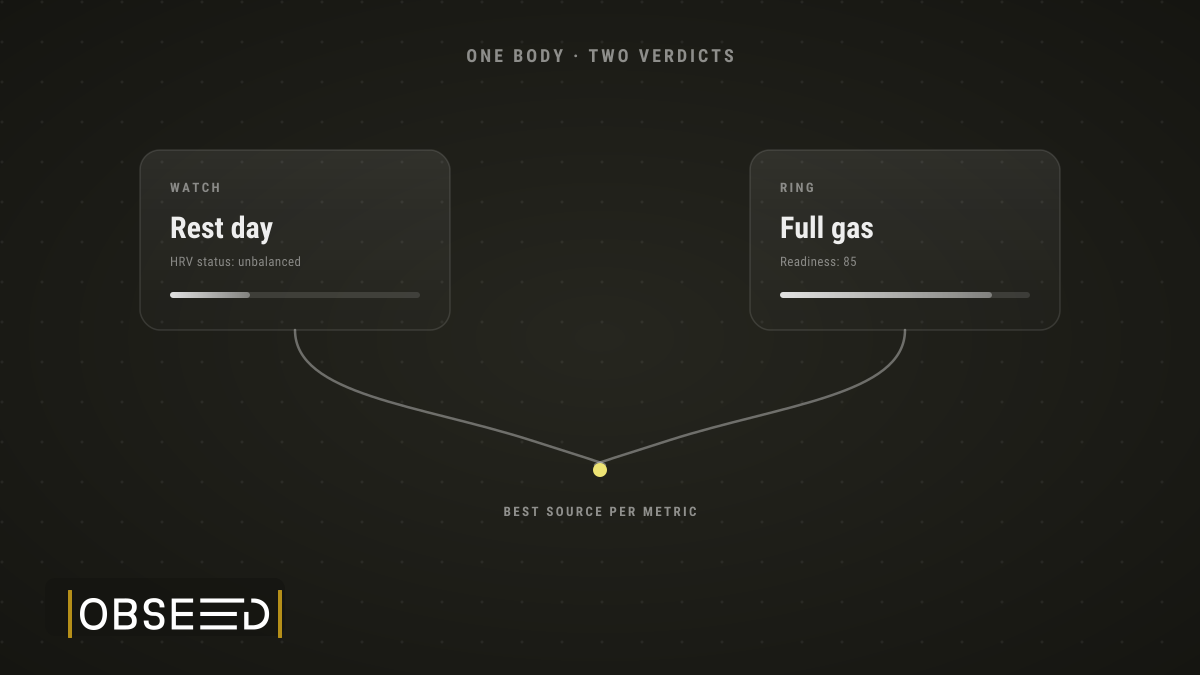
The Tracker Tango in the Data Jungle: Which Device Should I Believe?
Whoop says rest day, Garmin says threshold training. Why wearables contradict each other, and why your measurement method matters more than who is right.

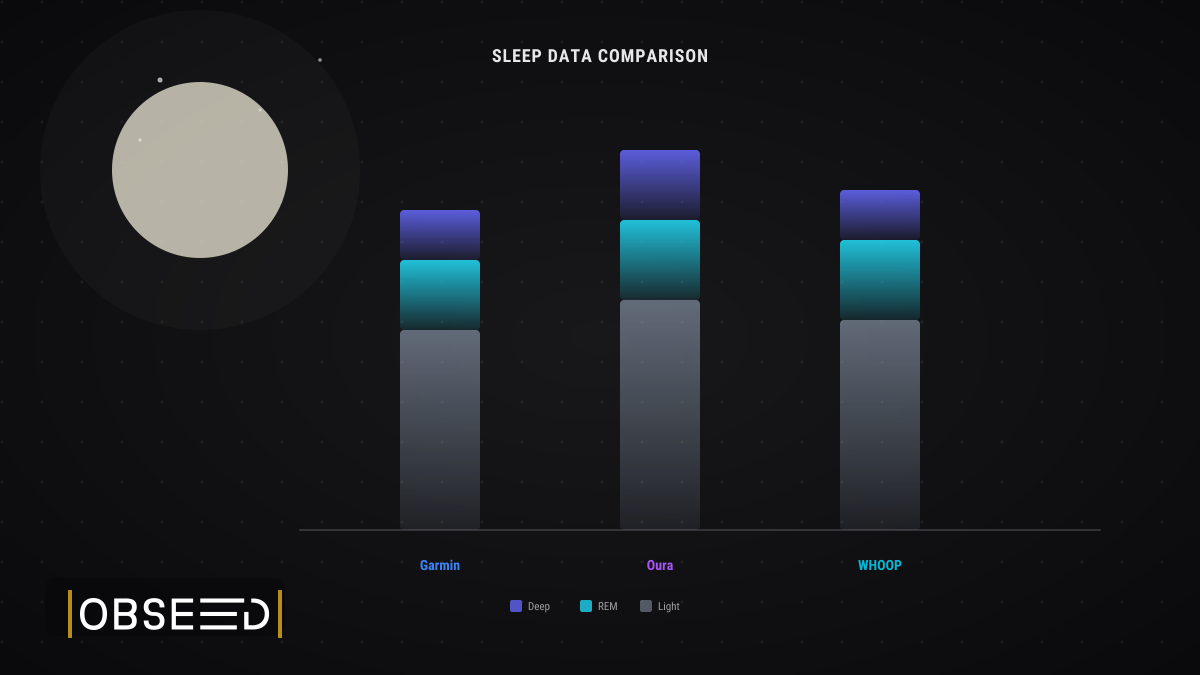
Garmin vs Oura vs WHOOP: Which Gives You Better Sleep Data?
Sleep tracking accuracy and metrics of Garmin, Oura Ring, and WHOOP compared. Which device gives endurance athletes the most useful sleep insights?

Garmin & HRV: Turn On Recording — and Re-Check It After Every Update
On many Garmin watches HRV recording is off by default and gets reset by firmware updates. Here is how to enable it so obseed can analyse your HRV.