FTP
FTP (Functional Threshold Power) is the maximal power an athlete can theoretically sustain for one hour; the term was coined by Andrew Coggan.
Definition
“FTP” stands for “Functional Threshold Power”: the maximal power an athlete can produce for one hour. The term was coined by sports scientist Dr. Andrew Coggan and the company TrainingPeaks. Its origin lies in the attempt to define the anaerobic threshold determined in performance diagnostics without spiroergometry or lactate measurement.
Why it matters
Through research and field tests Coggan created a test protocol that, in various runs with cyclists, produced power values matching the threshold values determined in the lab. Subsequent research and repeated, sometimes incorrect translation, however, soon led to “FTP” being equated with “anaerobic threshold”. That is not correct.
In well-trained athletes functional power is indeed often located near the anaerobic threshold, but it can just as well sit above or below it. The reason is simple: FTP is a kinematic, time-based power value, i.e. a power that can be maximally produced at the muscular level over a defined time. The anaerobic threshold, by contrast, marks a transition point at the respiratory level from which inhaled oxygen can no longer be reliably taken up.
| Quantity | Level | Determination | Statement |
|---|---|---|---|
| FTP | muscular, time-based | field test, 20 or 60 min | maximal one-hour power |
| Anaerobic threshold | respiratory, metabolic | spiroergometry | transition of energy provision |
| Lactate threshold | blood value | lactate step test | lactate accumulation |
Nevertheless it has become customary even in scientific circles to lump functional power, anaerobic threshold and lactate thresholds together. This carries the risk that the training focus does not match the intended emphasis.
The theory is also based on values almost exclusively from male, well-trained subjects and was validated on a tiny reference group. If the same statements are made in recreational sport without verification, training matches the intended focus by chance at best and in most cases turns out far too intense.
How obseed measures it
obseed does not compute an FTP from recordings and derives no physiological thresholds from it. Traditionally, performance diagnostics use the anaerobic threshold to define training zones; if a metabolic analysis underlies this data, reliable statements about function under load are possible. If only a single value determined in the field is available, there is no way to verify whether the intended stimuli are actually triggered.
FTP is not a value plucked from thin air, though. Correctly determined and continuously updated, it allows a relatively objective load assessment via the calculated TSS. In obseed you store FTP for different sports under body data in “performance values”: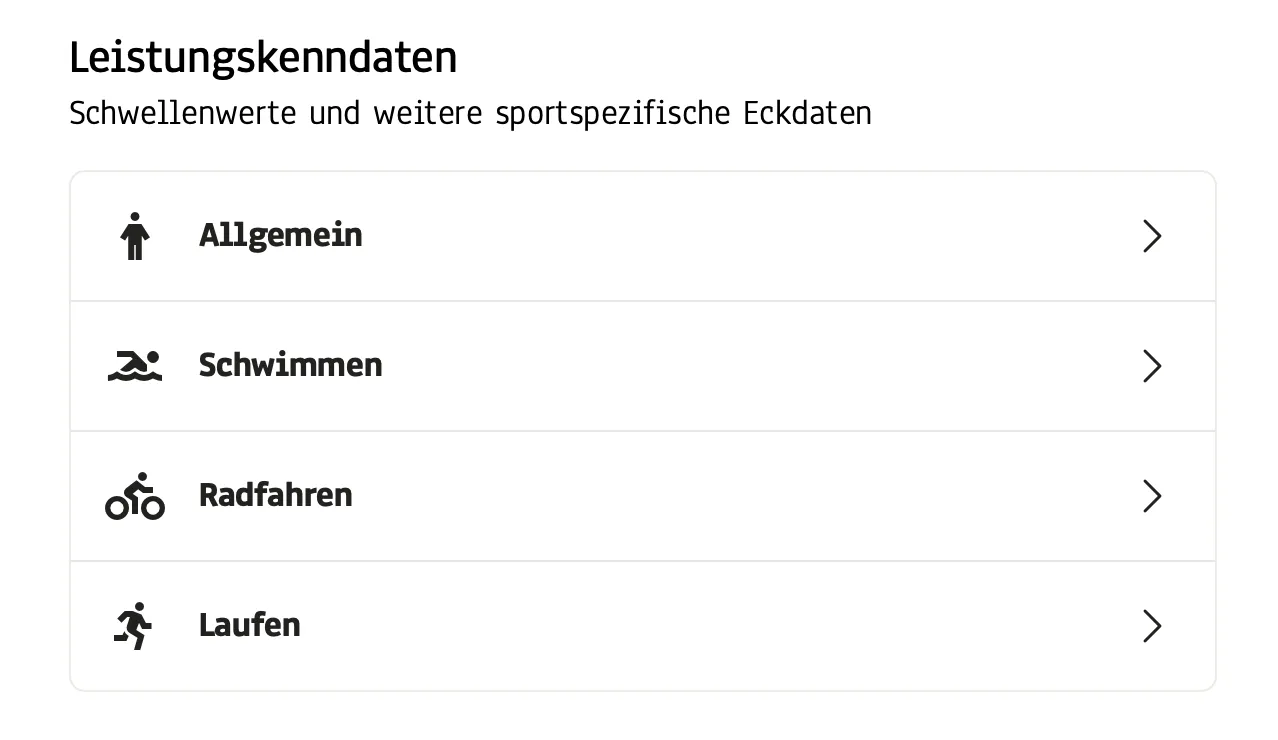
These functional values are then used to calculate your training zones and quantify your recorded sessions.
Example
An athlete stores an FTP of 250 W and rides a 90-minute session with a normalized power of 200 W.
IF  = 200 W / 250 W = 0.80
TSS = 90 min × 0.80² / 60 × 100 = 96
In her diagnostic the anaerobic threshold sits at 232 W. Relative to that value the same session yields an IF of 0.86 and a TSS of 111. The difference of 15 points per session adds up over weeks to a systematically underestimated load.
References
- Allen, H. & Coggan, A.: “Training and Racing with a Power Meter”.
Categories
- Diagnostik
- Technische Begriffe