Data sovereignty
Data sovereignty is the principle that you decide which connected device or app is the authoritative source for each type of data in obseed.
Definition
“Data sovereignty” is the principle that users decide for themselves which connected data source is authoritative for which type of data in obseed. Instead of a platform dictating precedence, you choose per data set whether sleep, heart rate, weight or training recordings should come from the wearable, the sports watch or a third-party app. The principle covers two levels: which source counts and who owns the data.
Why it matters
Many people now own more than one device that produces data about their body, sport and health. A ring analyses sleep, the sports watch records training, a scale sends weight to a third app. Keeping an overview is laborious, relating the data to each other a real challenge.
Without sovereignty, conflicts also arise. Two devices report different resting heart rates, and depending on which syncs first, the analysis changes. Training control based on such values becomes a matter of chance.
| Data type | Typical sources | Why a choice is needed |
|---|---|---|
| Sleep, HRV, resting HR | ring, wearable, sports watch | sensors and algorithms differ markedly |
| Training recordings | sports watch, bike computer, platform export | duplicate sessions distort TSS and CTL |
| Weight, body composition | smart scale, manual entry | frequency and method differ |
| Performance values | lab diagnostics, field test | diagnostic values must not be overwritten by estimates |
What obseed guarantees
Directly in the settings you connect several profiles and import their data: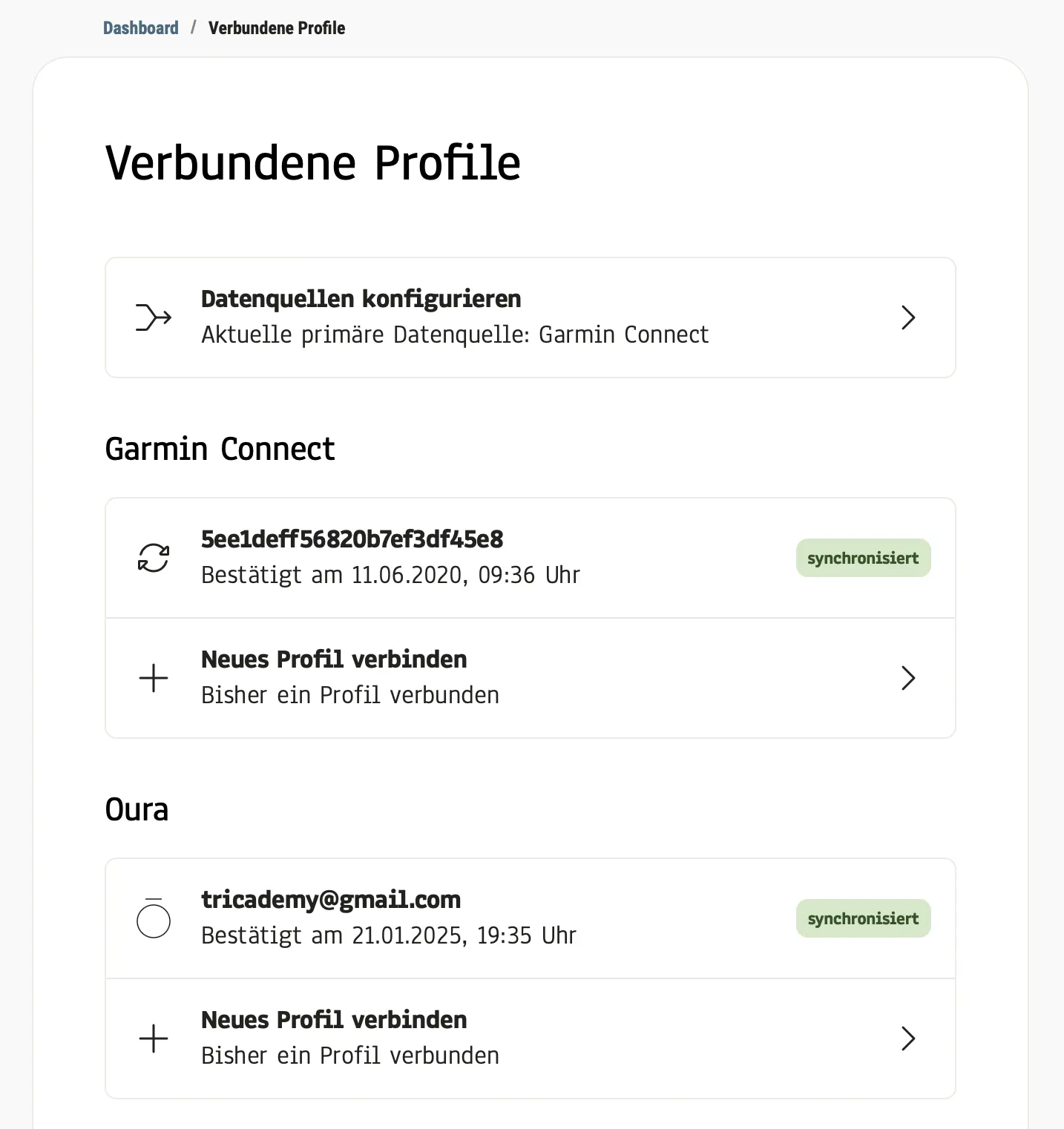
In a second step you define per data type which source is preferred. That choice stands until you change it; obseed does not overwrite it automatically when another device is added. This makes it possible for the first time to relate data produced by different devices and stored in different apps.
The data remains your data. It is stored for your analyses, and which source counts is decided by you alone. The list of compatible profiles is being extended continuously; it is our declared goal to offer a complete solution here.
Example
An athlete wears an Oura ring at night and trains with a Garmin watch. Both report a resting heart rate.
Oura, overnight:         44 bpm
Garmin, daily minimum:   49 bpm
Difference:               5 bpm (roughly 11 %)
In obseed she sets: sleep, HRV and resting HR from the Oura ring, training recordings from Garmin, weight from manual entry. If resting HR according to Oura rises to 49 bpm for a week, that is a genuine signal of fatigue or infection, not an artefact caused by the watch happening to sync first.
Categories
- Gesundheit
- Datenanalyse
- Technische Begriffe