Aerobic Decoupling
Aerobic decoupling is the percentage rise in heart rate at constant power or pace over the course of an aerobic session; below 5% is considered stable.
Definition
“Aerobic decoupling” (often abbreviated Pw:Hr or Pa:Hr) is the degree to which heart rate drifts upward at constant power or pace over the course of an aerobic session. It is measured as the percentage change in the ratio of output to heart rate between the first and second half of a time interval. A value below 5% is considered stable and indicates good aerobic efficiency.
EF         = power (or pace) / heart rate
Decoupling = (EF_first half − EF_second half) / EF_first half × 100%
Why it matters
If heart rate rises while output stays the same, the work is no longer primarily covered aerobically, or fatigue is setting in. Decoupling is therefore a simple indicator of whether the chosen intensity actually stayed in the aerobic range for the duration of the session.
| Decoupling | Interpretation |
|---|---|
| below 5% | Aerobically stable, intensity and duration match |
| 5 to 10% | Borderline: intensity too high, duration too long, or external factors |
| above 10% | Marked decoupling, load no longer covered aerobically |
The value does not respond to physiology alone, though. Heat, dehydration, caffeine, lack of sleep and altitude all push heart rate up. A single high value is therefore not a finding but a cue that has to be read in context.
How obseed measures it
obseed calculates decoupling from every recorded session as long as power or pace and heart rate are present. The value is shown directly in the activity summary:
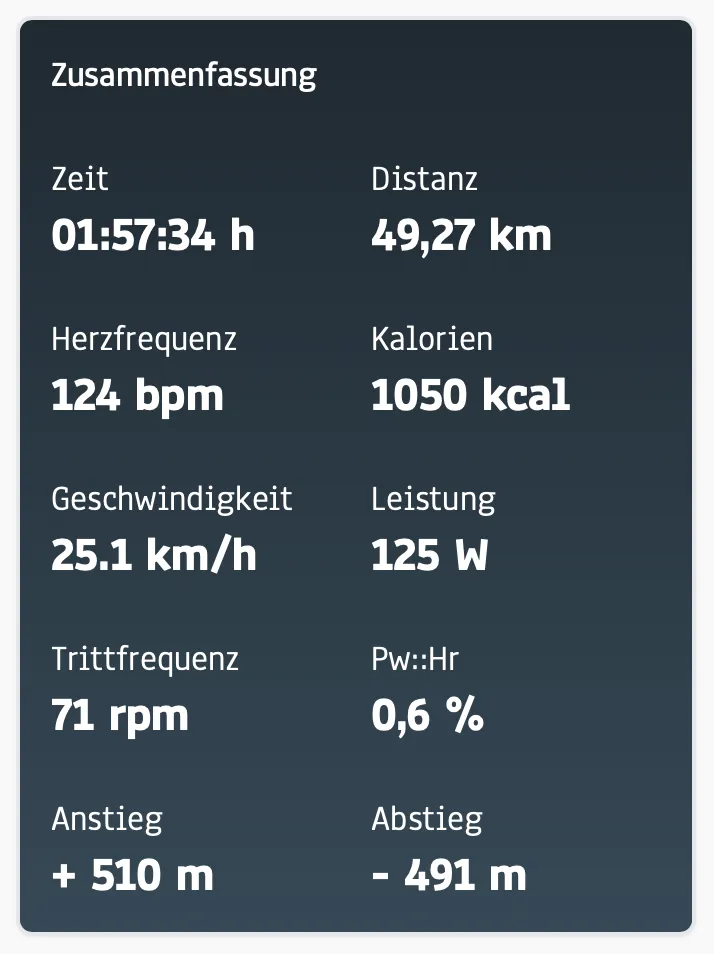
Beyond the per-session readout, decoupling can also be used as a dedicated test factor to take stock of aerobic fitness (see Decoupling tests). To do so, a longer session at constant output is repeated under conditions as similar as possible and the trend of the value is compared over weeks.
obseed treats decoupling as a trend metric, not as a substitute for diagnostics. Where the aerobic threshold really lies is only revealed by spiroergometry. Decoupling merely shows whether a session was ridden below or above that threshold.
Example
A rider goes for two hours at a constant 200 W.
| Segment | Avg power | Avg heart rate | EF (W/bpm) |
|---|---|---|---|
| First hour | 200 W | 140 bpm | 1.429 |
| Second hour | 200 W | 150 bpm | 1.333 |
Decoupling = (1.429 − 1.333) / 1.429 × 100% = 6.7%The value exceeds the 5% mark. Either 200 W for two hours was still slightly too much for the current aerobic base, or heat and fluid loss drove heart rate up. If the value drops to 2.5% under the same conditions after eight weeks of base training, that is a robust sign of improved aerobic efficiency.
Categories
- Technische Begriffe
- Diagnostik