What is obseed.me? A first look behind the scenes.
There are many sports platforms and apps these days. If a new demand arises, it usually doesn't take long for a corresponding offer to appear.

There are many sports platforms and apps these days. If a new demand arises, it usually doesn’t take long for a corresponding offer to appear. Viewed from this angle, the legitimate question arises as to whether another platform is needed that… offers exactly what?
What is obseed.me?
More precise. More efficient. Better. We advertise with these three terms on our website. We also stick to these claims, because they summarize what we have set ourselves as a goal: instead of simply creating another and perhaps very specific, but also not very extensive sports app, we want to create a hub where ultimately all important data about sports, training and health can be collected. Not only that: we also want to enable users to actually analyze their data.
The blind spot on the Internet
“Actually analyzing” data sounds like we are doing something that doesn’t exist yet. can that really be?
The answer is a categorical, simple “Yes”: although these days you find a plethora of apps and platforms that allow, for example, viewing a recorded running training from different angles. What is not found anywhere, however, are the effects that not only a training, but regular and targeted training can have on the body. And not just over a few weeks, but over several years. Let’s look at some of the already applicable functions that obseed.me has in store for users.
Disclaimer: Currently, training and other data can only be imported directly via Garmin. Other formats must still be uploaded manually at the moment.
Long-term development at a glance – and from two perspectives
To keep a common thread, let’s stay with the example of “running”. Anyone who regularly practices this wonderful sport knows that at times it often seems as if you are going in circles. You invest hours and hours, stay the same speed and wonder at some point if everything is going right. Perhaps it is worth looking a little outside the box in exactly such a case and looking at the big picture:

In the picture you can see quarter 3 of the year 2023 highlighted.
It is clearly visible that the ranges between 10.5 and 14.0 km/h show no major fluctuations, but clearly recognizable differences show below and above. What could be the reason for this?
Here the mentioned, second perspective helps us: the weighting of the data.
Specifically, this means that we have created the possibility at obseed.me for the first time not only to display the reaction of the heart rate to a run speed over longer periods. We also offer the option to directly visualize how said reaction came about by displaying at a glance how much time was trained at the respective tempos. For this, the “Weighting” button can be selected via the filter function, which results in the following graphic:

This function alone can help to understand the training and the resulting reactions of the cardiac output and to design the training accordingly for the future. But that is far from everything…
Running style analysis without running style analysis
Just the weighting of the data of speed and heart rate can give us first ideas of how the body develops in training. However, to understand the changes even more precisely, it is not enough. For this we offer another function that shows us not only how fast was run, but also how was run. let’s stay with the example of the 3rd quarter of 2023 and look at 3 values in turn that every better sports watch records quite automatically these days: cadence, ground contact time and vertical oscillation.
Cadence: Visualization of the physical work necessary for the pace

The combination of the two graphics therefore allows us a significantly deeper analysis: we can now assume that the solid-looking base in the range of 11.5 to 12.5 km/h arose because the training was also enriched with few, but very targeted intervals.
Time for the next step.
Ground contact time: A clue for efficiency, function and technique in one
The name says it already: this value shows us how long we spend on the ground with each step. Often, however, it is not clear that we can read many things from the course of these values.
To understand this, we have to delve a little into the matter.
As soon as we put our foot down at the end of a step while running, a process is set in motion that can be described roughly like this: First our shoes dampen the initial impact, then our feet react immediately. The body in motion must be prevented from being brought down by the combination of speed and gravity. So tendons, ligaments, muscles and joints of our feet react immediately: the pressure exerted by the body touching the ground is converted into tension, which is then converted back into pressure as part of the push-off again.
Let’s now look at the course of the ground contact time in the same period as before:

Very short GCT values indicate very high speed on the flat, because when running downhill very high speeds can be achieved very easily, but purely for physical reasons one stays on the ground longer than if one runs e.g. a sprint on a flat track. The slight increase at 14.5 – 15.0 km/h could therefore be an indication of running on a slope here, but carries hardly any weight.
Also when running uphill the GCT tends to be higher, which here supports the assumption that the slower tempos actually represent ascents.
Our next conclusion is therefore that not only a good combination of mostly regular basic training and targeted intervals have led to the existing form, but that this was also brought about by running in terrain.
The conclusion: vertical oscillation as a clue for endurance and resilience
While ground contact time can show us how efficiently a foot works, vertical oscillation shows us in addition how the force and energy for the pace is applied and whether it can be applied sustainably.
Here too, as simple as possible: vertical oscillation (VO) shows on the one hand whether the energy was used to move the body forward (low VO) or rather to move it upwards, i.e. against gravity (higher VO) and thereby tire it out in the long term.
The more exhausted the body, the more unstable the form and posture of the runner, which usually results in irregular and lower, vertical movements. Simply put, it can be quickly recognized whether sufficient energy is available to move the body sustainably against gravity – or whether one “sticks” more and more to the ground. The latter results almost exclusively in a significantly longer ground contact time. Together, the two values are therefore an excellent indicator for efficiency, fatigue and endurance.

Only with the sprints, which were identified in the uppermost areas, does the VO also drop significantly. Another indication that work was actually done here with high-intensity intervals that also involve the fast muscle fibers.
Long-term analysis provides information about training quality
Training a lot is easy, training with high quality, on the other hand, is a big challenge.
With the basic functions of long-term analysis, obseed.me already offers in the now available version the unique option to analyze the training of several years for its efficiency with a few clicks and draw conclusions from it.
Are you interested in trying this out yourself? Then you have the chance here: simply register on obseed.me, create an account and connect it to your Garmin account. Afterward you have the opportunity to display your last years at a glance after the import.
What do you see? Sincerely,
Your team from obseed.me!
Read Next
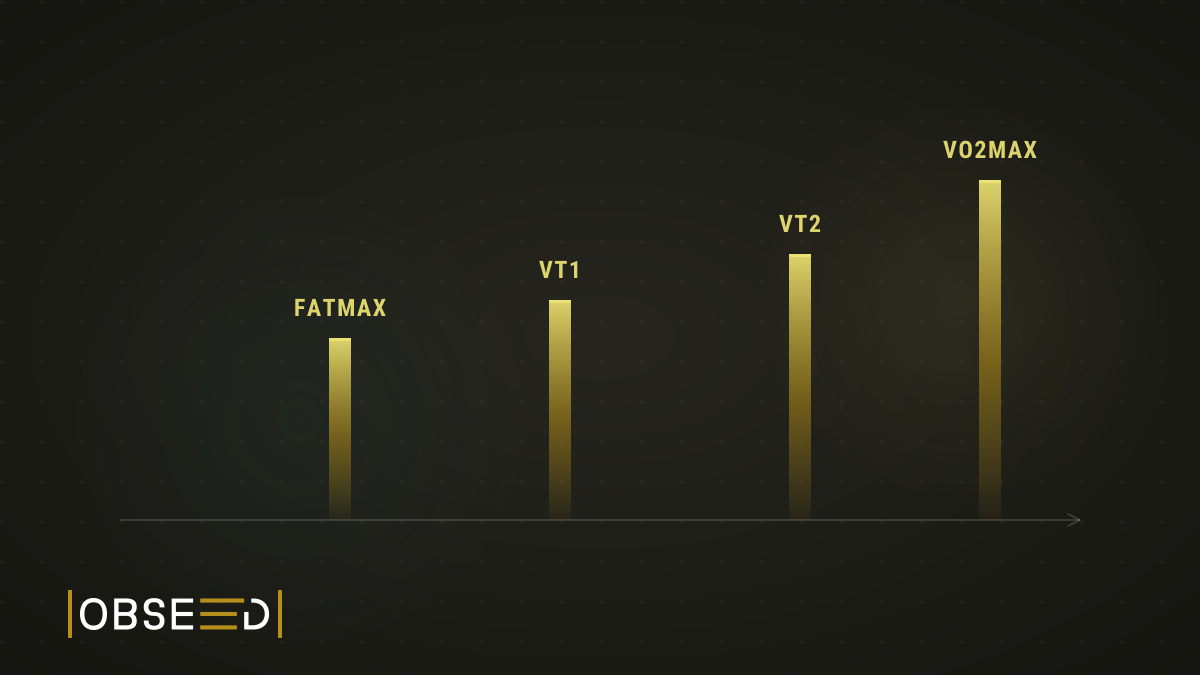
Thresholds and Maximum Values: The Who's Who of Diagnostics
VO2max only tells you what would theoretically be possible, not what your body actually uses of it. And when it comes to pinning down your second lactate threshold, not even the 72 recognised models can agree.

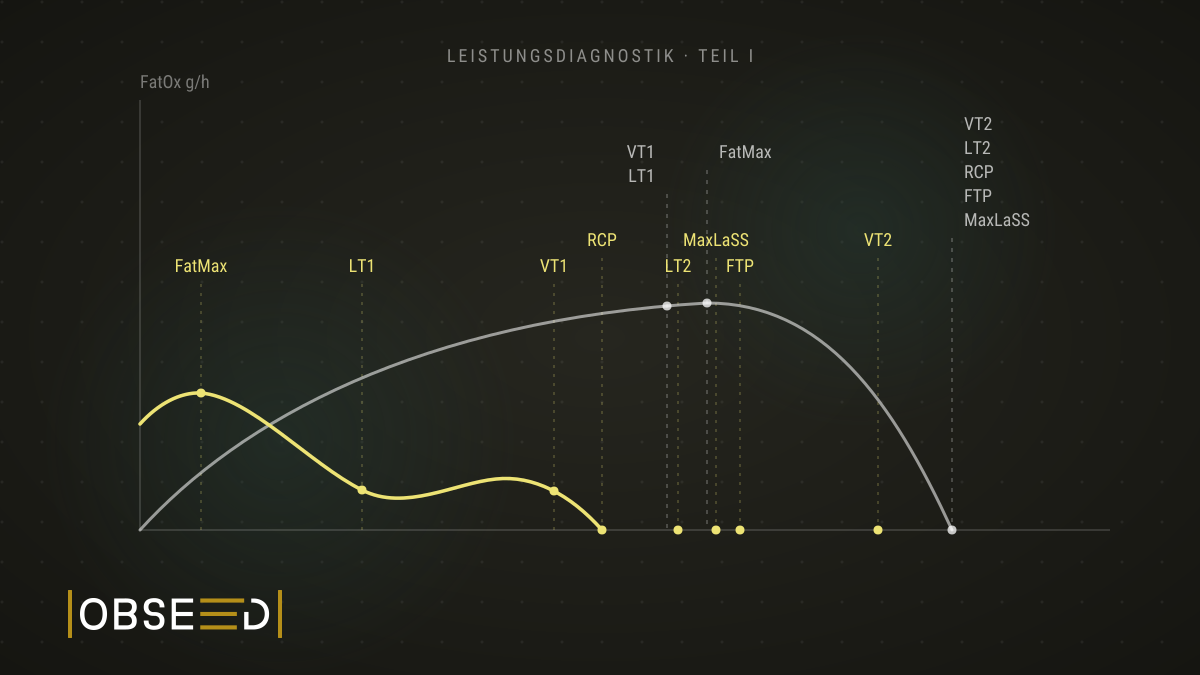
Performance Test vs. Diagnostic: What Is the Difference?
A test shows you WHAT a body can do. A diagnostic shows you HOW it does it. Why that difference decides whether your Zone 2 is actually a Zone 2.
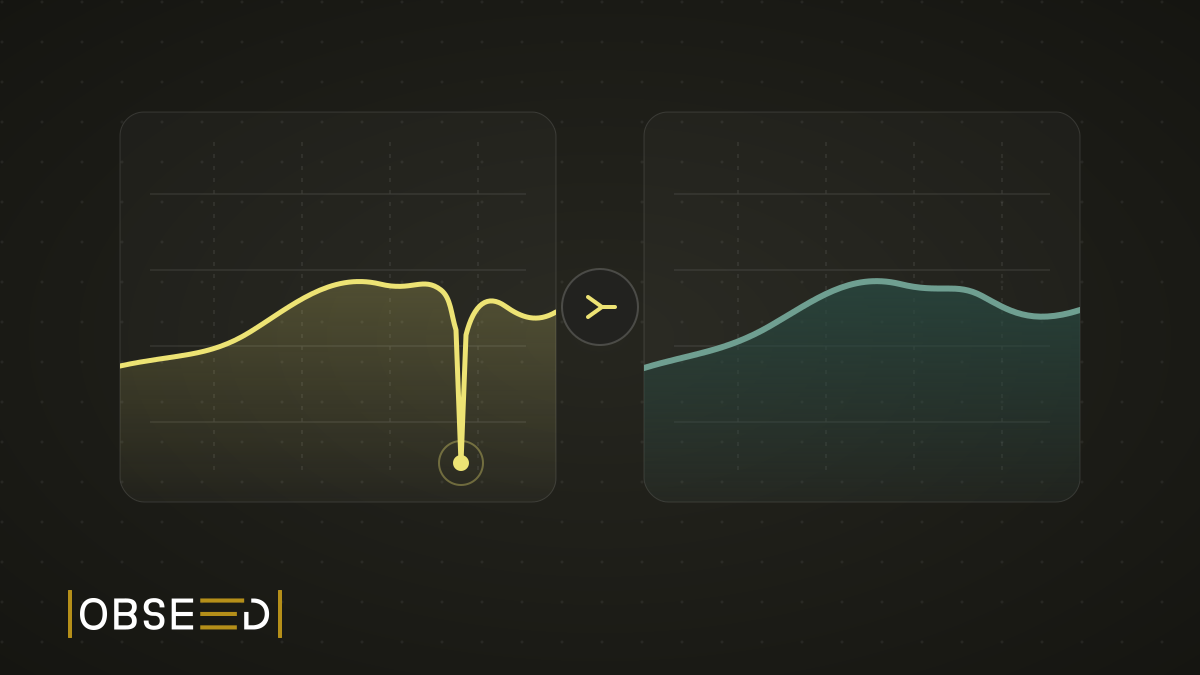
New Feature: The Mountain That Never Happened
My watch went for a swim in a fountain and invented roughly 100 metres of climbing. obseed now corrects errors like this automatically, including in your old sessions.
